
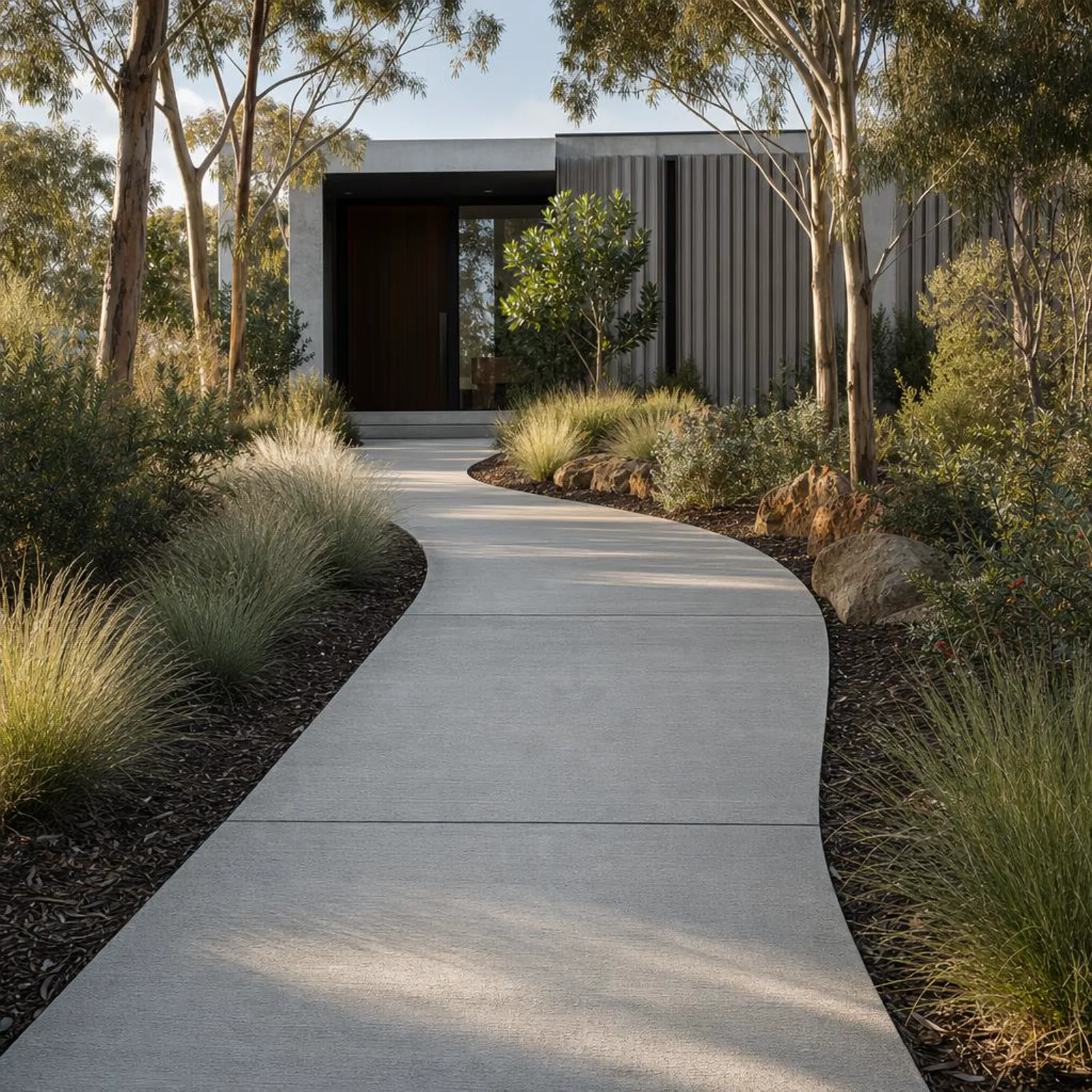
Concrete paths
for the way you move.
Paths link the places you use most: the gate and front door, the clothesline, the bins, the garden. They should feel natural to walk and stay usable in all weather.
Start a conversationA path is defined by where people actually walk.
The best route is often the one already worn into the lawn. We look at the journeys around your property, how wide each needs to be, and where wheelie bins, prams or wheelbarrows will travel.
Side passages often deal with water from roofs and neighbouring properties, so falls and drainage need thought. In the garden, a path can be crisp and straight or follow a gentle curve. Either way, clean edges and well-placed joints make it look intentional.
We work with homeowners across Newcastle, Lake Macquarie, Hunter and Central Coast.
What to
think about.
- 01Route and width
- Planned around everyday journeys and what needs to move along them.
- 02Side passages
- Narrow areas often collect water and have limited access for equipment.
- 03Steps and slopes
- Changes in level may call for steps or gentle ramps, planned for safe footing.
- 04Edges and joints
- Straight or curved, the edge line and joint spacing give a path its finished look.
- 05Grip in the wet
- A textured finish helps paths that are shaded, sloping or often damp.
From first call
to handover.
Every site is different, so steps can shift. This is the usual shape of the work. Timing depends on the scope, the site and the weather.
- 01
Conversation
Where you need to get to, and what currently gets in the way.
- 02
Site walk and measure
We follow the routes, check levels, drainage and access.
- 03
Scope in writing
Route, width, finish, steps, edges and any removal work.
- 04
Preparation
Excavation, base and formwork set out to the agreed line.
- 05
Pour and finish
The path is poured, finished to the agreed texture and jointed.
- 06
Curing and handover
Guidance on when it can be walked on and how to look after it.
Worth
asking.
Have a question that is not here? Ask it in your enquiry.
Can a path follow a curve?
Yes. Curved paths take more formwork care but can sit beautifully in a garden setting.
How wide should a path be?
It depends on use. A route for bins or wheelbarrows needs more room than a stepping route through planting. We discuss what suits each path.
Can you fix water pooling in my side passage?
Often, new falls and drainage planning can improve how water moves. We will look at where the water is coming from first.
Can paths be done with a patio or driveway?
Yes. Planning connected surfaces together usually gives a more consistent result and cleaner junctions.
Planning
concrete paths?
Tell us where you are and what you have in mind. The enquiry form is on our homepage.
Go to the enquiry form